Market Disruption: How Enact Is Reshaping Its Industry with Scaled Infrastructure

Written By
Arjun Goyal
In a strategic move highlighting surging investor appetite, Enact has announced significant operational momentum, marking a key inflection point in its international growth strategy.
HomeSwitzerland-StartupsBacked by Yann LeCun and Arthur Mensch, Swiss Physical AI startup Enact...
Operational Scale and Core Technology
FundingSwitzerland-Startups Backed by Yann LeCun and Arthur Mensch, Swiss Physical AI startup Enact Intelligence exits stealth with €26.68 millionShare FacebookTwitterWhatsAppLinkedin
Strategic Vision and Market Disruption
Enact Intelligence, a physical AI startup headquartered in Zurich, has come out of stealth today with a €26.68 million ($30 million) pre-Seed funding round, one of the largest pre-Seed raises in Europe to date.The round saw participation from institutional investors redalpine, Notion Capital and firstminute capital, alongside a notable slate of angel investors, including Arthur Mensch, founder of Mistral; Yann LeCun, founder of AMI Labs and former Chief AI Scientist at Meta; and Andrew Lonsberry, founder of Path Robotics.
“Dexterity is the next frontier in robotics, and Enact is tackling it with a new data modality: starting with high precision force data from bespoke actuators they are rethinking the entire stack from the hardware up. We are very excited about Enact’s approach of leveraging orthogonal data to improve existing models and build a data moat,” said Dr. Harald Nieder, General Partner of redalpine.
Founded in March 2026 by Manuel Yves Galliker, Enact is building robots that can not only see their environment but physically sense what is happening when they interact with it. Before founding Enact, Galliker led the software team for the humanoid robot NEO at 1X, helped build 1X’s AI team in Silicon Valley, and went on to work at the robotics lab Physical Intelligence.
The central argument of Enact is that most robots today depend almost entirely on vision to perceive their surroundings, limiting their ability to manipulate objects reliably or learn efficiently from experience. Existing haptic sensing solutions, which extend robots with force and touch, are either too costly or fragile for meaningful industrial deployment.
To solve this physical AI challenge, Enact rethinks the entire stack, from model architectures and data pipelines through to the actuators and sensors that feed the model. As a departure from traditional robots relying on point-based force sensors, Enact’s robots capture force data directly from the actuators themselves, similar to how humans sense tension through their muscles rather than solely through their fingertips.
Manuel Yves Galliker, CEO and founder of Enact Intelligence, said, “Unlike the early days of LLMs, physical AI has the advantage of starting from strong reasoning, language, and vision capabilities already in place. Instead of trying to collect every piece of data needed to teach a robot common sense about the world, we can build on top of existing models, like video models, and adapt them to output robot actions for interacting with the real world. So what we are addressing is the ability to efficiently learn from experience and perform tasks reliably, both of which require the model to understand the physics of the robot and the task at hand.”
This approach, Galliker argues, will lead to the development of “a proprioceptive nerve system and the cortex that makes sense of it,” solving dexterity through whole-body force-awareness at a cost and reality-level suitable for industrial scale.
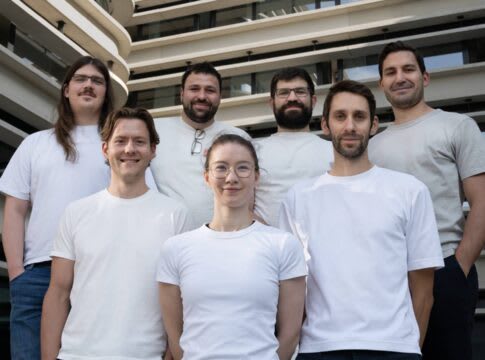
Enact’s twelve-person team draws its engineering talent from DeepMind, 1X, Amazon Robotics, Helsing, Physical Intelligence and ETH Zurich. Alongside the funding, the company announced bringing Philip Kneis, a former DeepTech investor at redalpine, to lead growth.
“Silicon Valley has traditionally been very strong in software and AI, but it’s lacking in robotics and hardware engineering talent, and with the current excitement around robotics a lot of money is chasing a few people. What we will do is bring the AI experience with us from Silicon Valley and combine it with Zürich’s local talent pool. That’s the winning formula,” added Galliker.
The fresh capital will be used to grow its team fivefold by the end of 2027, accelerate its hardware and R&D pipelines, and roll out its robots with multiple industrial partners across manufacturing, infrastructure, retail, and food processing.
Share FacebookTwitterWhatsAppLinkedin
Previous articleThere’s no stopping Legora – €489 million for Stockholm’s LegalTech Unicorn
in-Chief of SiliconCanals. In December of 2025 he joined Startups
Bern-based Besso raises €4.29 million to scale its AI-powered trade regulation intelligence platform
Mistral raises €3 billion Series D led by Samsung at over €21 billion valuation
Zurich-based xorlab secures €5 million to scale sovereign email security across Europe
Gravis Robotics becomes Europe’s latest unicorn after €172 million Series A
Switzerland-Startups off Aisot Technologies bags €2.13 million to bring agentic AI to portfolio management
Zürich-based Exclaim Robotics exits stealth with €4.29 million to build robots for AI data centre maintenance
Zürich-based ZuriQ raises €22.4 million to scale its 2D trapped-ion quantum processors
Dutch startup New Dawn Bio raises €2.1 million to grow wood from tree stem cells in bioreactors
Mistral AI extends a year of outsized expansion with €722 million to deepen Europe’s AI infrastructure
March 30, 2026 By Country
2048 Puzzle Game New York City, United States of America
Europe Ethical Hacking & Penetration Testing | 20% Uncapped Commission | Remote Telecommute, Portugal
Staff Accountant new york, United States of America
Google Chrome Space Themes: Install and Remove Fast Jaipur, India
Senior sales and marketing Expert $80/hr [Remote| part time| $1600/week] Anywhere, Worldwide Remote, United Kingdom
Discover moreTech startup insightsSmall business marketingVenture capital reports
There’s no stopping Legora – €489 million for Stockholm’s LegalTech Unicorn
Fuse Energy bets on NVIDIA GPUs as it expands from energy supply into AI infrastructure
Eindhoven-based Photon Bridge raises €10 million to build optical engines for AI and telecom
Britain’s Skyfly raises €8.91 million to bring its two-seat Axe eVTOL to market and develop Longbow for defence
Enact Intelligence, a physical AI startup headquartered in Zurich, has come out of stealth today with a €26.68 million ($30 million) pre-Seed funding round, one of the largest pre-Seed raises in Europe to date.
The round saw participation from institutional investors redalpine, Notion Capital and firstminute capital, alongside a notable slate of angel investors, including Arthur Mensch, founder of Mistral; Yann LeCun, founder of AMI Labs and former Chief AI Scientist at Meta; and Andrew Lonsberry, founder of Path Robotics.
“Dexterity is the next frontier in robotics, and Enact is tackling it with a new data modality: starting with high precision force data from bespoke actuators they are rethinking the entire stack from the hardware up. We are very excited about Enact’s approach of leveraging orthogonal data to improve existing models and build a data moat,” said Dr. Harald Nieder, General Partner of redalpine.
Founded in March 2026 by Manuel Yves Galliker, Enact is building robots that can not only see their environment but physically sense what is happening when they interact with it. Before founding Enact, Galliker led the software team for the humanoid robot NEO at 1X, helped build 1X’s AI team in Silicon Valley, and went on to work at the robotics lab Physical Intelligence.
The central argument of Enact is that most robots today depend almost entirely on vision to perceive their surroundings, limiting their ability to manipulate objects reliably or learn efficiently from experience. Existing haptic sensing solutions, which extend robots with force and touch, are either too costly or fragile for meaningful industrial deployment.
To solve this physical AI challenge, Enact rethinks the entire stack, from model architectures and data pipelines through to the actuators and sensors that feed the model. As a departure from traditional robots relying on point-based force sensors, Enact’s robots capture force data directly from the actuators themselves, similar to how humans sense tension through their muscles rather than solely through their fingertips.
Manuel Yves Galliker, CEO and founder of Enact Intelligence, said, “Unlike the early days of LLMs, physical AI has the advantage of starting from strong reasoning, language, and vision capabilities already in place. Instead of trying to collect every piece of data needed to teach a robot common sense about the world, we can build on top of existing models, like video models, and adapt them to output robot actions for interacting with the real world. So what we are addressing is the ability to efficiently learn from experience and perform tasks reliably, both of which require the model to understand the physics of the robot and the task at hand.”
This approach, Galliker argues, will lead to the development of “a proprioceptive nerve system and the cortex that makes sense of it,” solving dexterity through whole-body force-awareness at a cost and reality-level suitable for industrial scale.
Enact’s twelve-person team draws its engineering talent from DeepMind, 1X, Amazon Robotics, Helsing, Physical Intelligence and ETH Zurich. Alongside the funding, the company announced bringing Philip Kneis, a former DeepTech investor at redalpine, to lead growth.
“Silicon Valley has traditionally been very strong in software and AI, but it’s lacking in robotics and hardware engineering talent, and with the current excitement around robotics a lot of money is chasing a few people. What we will do is bring the AI experience with us from Silicon Valley and combine it with Zürich’s local talent pool. That’s the winning formula,” added Galliker.
The fresh capital will be used to grow its team fivefold by the end of 2027, accelerate its hardware and R&D pipelines, and roll out its robots with multiple industrial partners across manufacturing, infrastructure, retail, and food processing.
🔗 Verified Company & Founder Interlinks
* Company Profile: Enact on LinkedIn * Investors & Backers: * at redalpineArjun Goyal
Tech Journalist & Senior News Contributor
Arjun Goyal is an experienced tech journalist and senior editorial contributor at Prime World Media, formerly serving as an editor and lead technology correspondent across premier digital publications. In December 2025, he joined Prime World Media as a tech news contributor, covering global startup stories, venture ecosystems, and breakthrough technological innovations on a daily basis.